The all-new www.sp-ark.org site will be launched this September, including thousands of new archive materials and a unique video browsing interface

SP-ARK – The Sally Potter Online Archive
"SP-ARK gives us a glimmer of the future today. Instead of locking archive materials away and restricting availability, it promises ready access to anybody anywhere with a computer and the internet.”
Professor Chris Berry
Film and Television Studies
Goldsmiths College, University of London

“FABULOUS! We welcome enormously such an online project…Count us in!”
Professor Susan Hayward
Director of Film Studies
University of Exeter

“A really exciting development - invaluable for students and researchers too.”
Dr Andrew Spicer
Programme Leader, Department of Film Studies
University of the West of England, Bristol

“A great project.”
Professor Sue Thornham
Head of Department (Media & Film)
University of Sussex

What is SP-ARK?

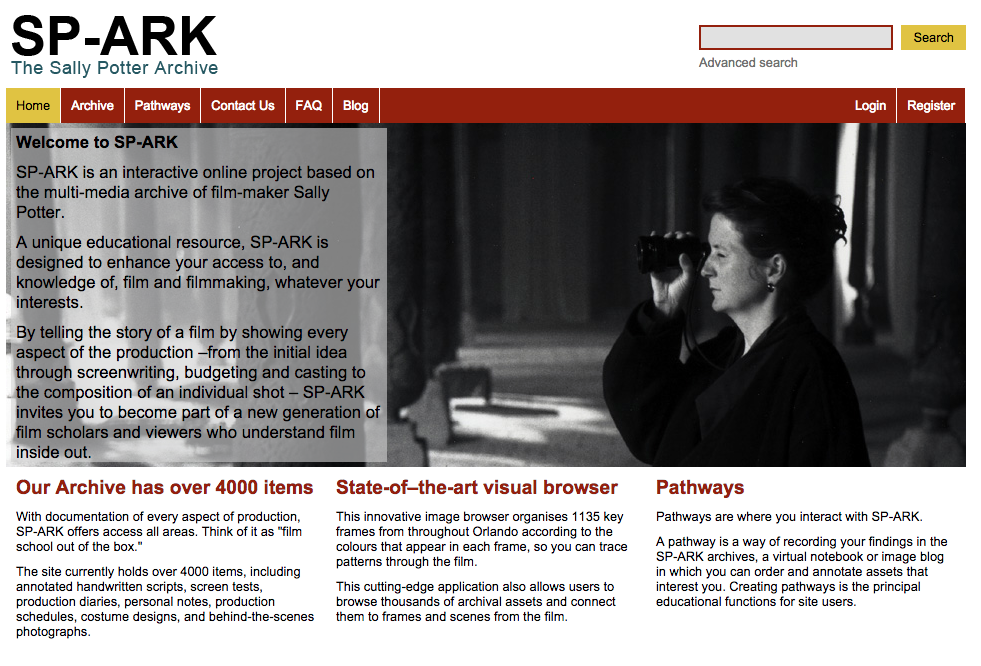
The SP-ARK project is an online education resource based on the working archive of Sally Potter, one of the UK’s foremost film directors. This extensive, unpublished archive relates to all aspects of Potter’s career as a writer, director, choreographer and composer. Its unique content ranges from annotated scripts, screen tests and production diaries, to personal notes, production schedules, budgets and behind-the-scenes photographs.

SP-ARK is pioneering an entirely new approach to the use of archive material as an educational resource. It is unique in allowing students, scholars and film fans to interact, not just with its database of thousands of digitised materials relating to every aspect of filmmaking, but also with each other, offering chance encounters with other users in a global online community who may share similar interests - and the opportunity to dialogue with them via a dedicated instant messaging system.

SP-ARK also tackles a problem that all traditional archives are now facing: how to provide enhanced access to hard-to-find materials in the digital age? The days when scholars were obliged to travel across the globe to visit an archive or museum to conduct their research may soon be over. SP-ARK provides a model, not just for other filmmakers, but for anyone working in the arts, science or technology who wants to make their archive materials available online in a genuinely interactive environment. For the first time, this will make original archive research accessible and affordable to individuals at every level of education

The development of SP-ARK began with the goal of providing an A-Z of filmmaking via an online platform. But it soon became apparent that to be really successful in reaching a generation of students raised on online social networking, SP-ARK would have to allow users to interact in real time. The aim was to allow an online community to collaborate and share ideas, making SP-ARK an interactive education tool rather than just a passive archive of materials.

The unique innovative aspect of SP-ARK is that it pulls together the ability of Web 2.0 to host and stream multimedia with its social networking capabilities, allowing users to tag and blog their way around the SP-ARK database, as well as commenting on blogs by other users, who could be senior academics, Potter’s collaborators, students or fans, from either the same college course or anywhere in the world. We are calling this unique kind of linked blogging a “pathway”, which allows users to attach notes to a series of objects chosen from the archives and then saved as thumbnails. The pathway also provides a unique assessment tool for students who can save them for submission to their tutors.

There is now a working prototype of SP-ARK which is being trialled in its beta phase at a number of partner education institutes in the UK, including London University’s Goldsmiths College and Queen Mary University. The response from students and lecturers has been overwhelmingly positive and we are now working together to improve the design and usability of SP-ARK.

As interest around SP-ARK continues to grow, Essex and Surrey Universities will begin collaboration in March 2010 on a six month “Knowledge Transfer Project (KTP)”, with a government grant awarded by the Technology Strategy Board. The KTP will see leading scholars from Essex University’s Department of Literature, Film and Theatre Studies and The University of Surrey’s Centre for Vision, Speech and Signal Processing develop a revolutionary image browsing interface that will be incorporated within SP-ARK, allowing users to visually analyse the film’s original rushes, from single frames to complete shots, and incorporate these in their pathways. This has never before been possible with a film archive.

At present SP-ARK hosts just a fraction of the available material for ORLANDO, Sally Potter’s 1992 Oscar-nominated film. The aim is to build SP-ARK’s database to accommodate all available material relating to Potter’s work, from the original concept for the film, through multiple drafts of the screenplay to budgets, shooting schedules and continuity sheets, showing how the finished film came together, and providing a resource that educates users in all aspects of filmmaking.

Our goal with SP-ARK is to provide a radically new and revealing experience of a multi-media archive for the social-networking age, which in turn provides a working model for innovative teaching and research, in all disciplines and at every level of education.

You are welcome to browse through the sample materials already available on the site, currently over 600 items. If you would like to access SP-ARK's unique interactive features and become a trial user participating in the testing and future development of this prototype then please email us at beta@sp-ark.org with some information about yourself and your interest in SP-ARK. We will send you a username and password.

An introduction to SP-ARK from Sophie Mayer, our Education Consultant.

The first film that Sally Potter ever exhibited publicly – in London in 1968, ten years before Thriller made its first appearance – was the backdrop to a dance piece called Daily. A very early example of multimedia in live performance, it was, though, more than a backdrop. It showed the dancers in ‘daily’ acts in their houses, like cleaning and watering plants. On stage, the same dancers repeated the gestures shown on the film, interacting with their screen avatars. Potter produced something similar, albeit on a larger and more complex scale, for Combines (1972), a legendary piece by Richard Alston’s Strider company, of which Potter was a founding member. Blown-up Polaroids of the dancers in rehearsal dominated the stage and projected behind them was looped rehearsal footage repeating single gestures.

At the end of the film there is a sequence that stands out: no longer focused on the dancers in the rehearsal space, it shows bodies jostling as they climb the stairs. In a witty echo of the iconic opening scene of Michael Powell and Emeric Pressburger’s The Red Shoes, in which the balletomanes and opera lovers race each other up the stairs at Covent Garden, the final sequence of Combines impossibly shows the show’s audience rushing in. Potter went on to experiment with using CCTV camera relays within live performance, an experiment that reached its apex in Carmen at the English National Opera in 2007, where Carmen first appears projected onto a scrim over the stage as she looks up into a CCTV camera located outside the Coliseum, the ENO’s home theatre.

For that production, Potter’s team and ENO Interactive built an innovative mini-site (including video clips that provide a complete education in how to stage an opera) But the Carmen site was only one strand of Potter’s commitment to outreach and interactivity. The latest move to bring the audience onscreen, as at the end of Combines, is a site called SP-ARK, the Sally Potter Online Archive. Just as a glimpse at the Carmen site could show you how to audition a chorus or do a sitzprobe, SP-ARK uses the materials from Potter’s private archives to provide an A to Z of filmmaking.

Now in its first phase of development, the SP-ARK site hosts just a fraction of the available material for Orlando and that’s still over 2500 individual items, from the original idea for the film through multiple drafts of the screenplay to continuity sheets showing how the finished film came together. And being a filmmaker’s archive, it’s multimedia, with video rushes, set photography and screen tests.

But unlike other online archives, this is not just a gallery of documents and objects but an interactive project designed to bring together filmmakers, film scholars and film viewers. The really innovative aspect of SP-ARK is that it pulls together the ability of Web 2.0 to host and stream multimedia and its social networking capabilities, allowing you to tag and blog your way around the site, as well as commenting on blogs by other users, who may be senior academics, Potter’s collaborators (such as composer and musician Fred Frith), students or fans. SP-ARK is developing a unique kind of linked blog called a pathway, where you can attach notes to a series of objects you’ve chosen from the archives. You can see the pathway idea being piloted– with Post-It notes, pushpins and string – by some brave and intrigued MA students from the Department of Media and Communications at London University’s Goldsmiths College, which is collaborating on testing of the SP-ARK prototype.

What that workshop showed is that new media is creating exciting new ways of thinking and organising information, in which audio-visual resources and the reader/user/viewer are coming closer together – something which Re:frame also builds on. It’s something that Potter’s work has explored with audiences and performers since Combines. Now SP-ARK takes this a step further by allowing its users, wherever they are in the world, to interact either by chance encounters when their pathways overlap or via a dedicated messaging system.

Re:frame’s users have an exclusive opportunity to become a part of this next-generation interactive audience for Potter’s work by contributing to the beta-testing of SP-ARK. You can sign up for a username and password by emailing beta@sp-ark.org. And the rest, as Orlando might point out, will be history!

Read the SP-ARK blog